


Bringing industry partners together for our regenerative agriculture roundtable
The Royal Countryside Fund (RCF) recently convened an industry roundtable, which was an opportunity for us to bring together our partners, funders and supporters to explore regenerative agriculture and discuss how we can work together across the sector to improve the outlook for family farms.

The theme of this event was how to make the regenerative transition more accessible for the small family farm. In this increasingly popular discourse, we reach the farming businesses that are at risk of being left behind. Evaluation of our programmes has shown that many initiatives and much advice available for transitioning to regenerative agriculture is tailored towards those who are already ideologically on board or have more confidence.
From our experience, we know that it is crucial that there is equivalent support available for family farming businesses to ensure the resilience of our food supply chains and a thriving future for the countryside.
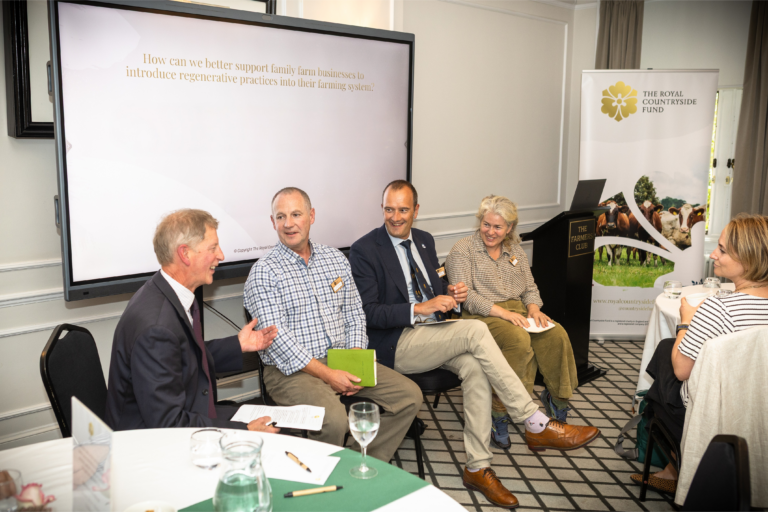
The key points to emerge from the discussions were:
- Profitability is a primary motivator for farmers. Becoming less dependent on external inputs and farmers taking charge of what’s within their control through regenerative practices is the key to becoming more self-reliant over the long term. Regenerative agricultural should be framed not only as an environmental solution, but also as an approach that can strengthen profitability, resilience and long-term business viability.
- The most effective support mechanism for encouraging farm businesses to move towards a regenerative model is peer-to-peer, “spades on farm” style engagement. Clusters and farm groups were identified as crucial opportunities for joint learning, mutual support, problem sharing, working together and even social company.
- Wider family and next generation engagement was identified as a key success metric. It was found in some cases that younger farmers were more willing to change, but that overall family alignment over a transition was vital for change.
- Resilience was a common thread throughout the discussion, whether to drought, flooding, market shocks or input costs, regenerative practices can be a solution to some of the common challenges facing farm businesses and their environments. There was caution against a reliance on premiums as these may diminish if regenerative proactive become more widespread.
In conclusion it was felt that what a successful regenerative transition looks like varies from farm to farm, but that it is less about reaching a fixed destination and more about building resilient, sustainable farming businesses that are moving in the right direction. Success should therefore be viewed through multiple lenses; environmental health, profitability, business resilience, food production, family engagement and the trajectory of change, rather than through a single measure or standard. Ultimately, a transition to regenerative farming must evolve alongside and in support of a viable farm business.
Click here to find out more about how we’re helping family farms become more resilient.
Tagged Farming, Rural communties, Scotland